 National Academy of Needlearts Gallery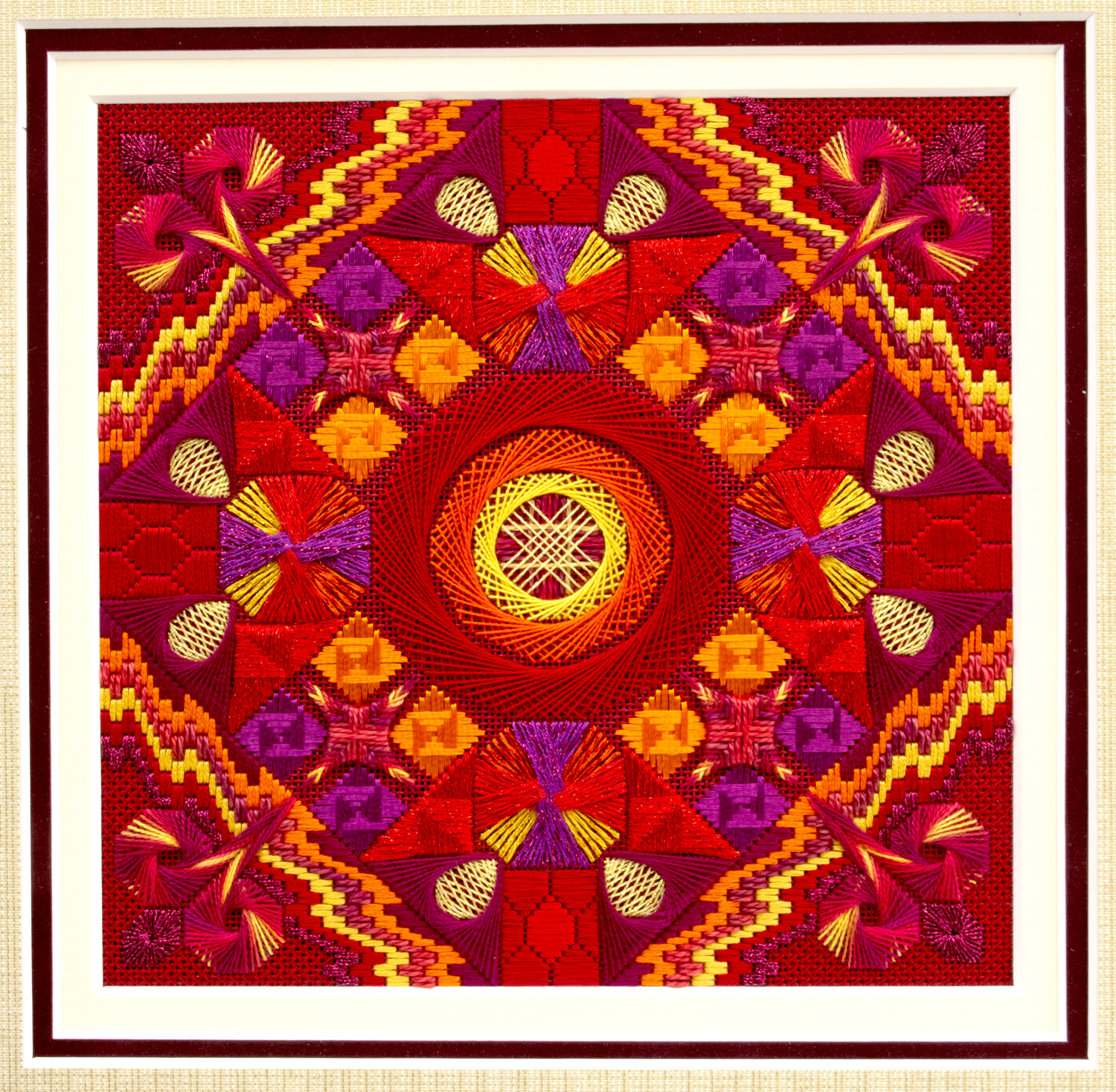
The Exemplary 2024
1st Place, Professioinal Non-Original with Instruction
“Sonata” was a class offered by the Needlework Guild of Minnesota; Debbie Rowley (DebBee’s Designs) was the instructor and designer. I was motivated to take the class because I’d never had a class with Debbie, and the style and colors made me think of my niece’s decorating taste.
The first challenge was that there was no stitched model for the colorway I’d selected, so I had to decide on color placement. Given how busy the design is, I opted for symmetric distribution of color around the central motif.
The second challenge was my decision to stitch the pairs of crescent stitches in the corners with overdyed thread instead of using the solid-colored pearl cotton called for. To make the crescents as visually effective as possible, I wanted the color variation/placement within all of them to be identical. That meant matching the color repeat in the space-dyed thread in 9-foot lengths, and then stitching with those same lengths.
The third challenge was my decision to change the stitch and thread selection in the cardinal blocks (north, south, east, west). These blocks lie between the Amadeus stitches and were filled with Victorian Step stitch worked in cotton and rayon floss. I opted to fill these spaces using a hexagonal lozenge pattern worked in cotton floss, with the central lozenge worked in Neon Rays.
The fourth challenge was modifying the corners. Several stitches filled these areas in the original design, making it very busy and to my eye detracting from it: Sprat’s Head, Rhodes, and Mosaic stitches (worked with Neon Rays and Kreinik braid; Flair; and cotton and rayon floss, respectively). I simplified these areas by placing a single hexagonal lozenge on the diagonal, nested against the Crescent stitches, and mirroring the lozenges in the cardinal blocks. As much as possible, I retained the Bargello design line touching the Crescent stitches, which was straightened in the original design. I filled the remainder of the corner spaces with the T stitch, worked using pearl cotton. The overall result is to keep the eye moving away from the center medallion, but not compete with it.
The fifth and final challenge was the four Mistake stitches. The original worked them entirely in Watercolors, but this thread was too heavy and distorted the canvas. I opted to work the first third of the stitch with Wildflowers, a lighter cousin of Watercolors available in the same colors, and finished the remainder with Watercolors,. Again, I wanted the color placement to be identical in all four stitches – and that meant careful monitoring of the changeover from one thread to the other to ensure correct color positioning in all four Mistake stitches.
When my niece moved into a new home with a lot of wall space, I offered it to her. She enthusiastically accepted it, and “Sonata” now hangs as a framed piece in her family room. The deal I cut with her was that I’d need it back to enter in exhibitions; there’s now a framed document hanging in its place that says ““Sonata” is currently on tour, please check back later.”


 National Academy of Needlearts Gallery